
Powering AI: The Trillion Dollar Infrastructure Challenge Facing Climate Reality
The infrastructure backbone of the artificial intelligence revolution is rapidly taking shape across the globe, as AI data centers experience unprecedented growth that's reshaping the landscape. What began as a niche infrastructure need just a few years ago has exploded into a multi-trillion-dollar boom, with tech giants and cloud providers racing to build massive facilities capable of handling the enormous computational demands of training and running AI models. Big Tech (OpenAI, Microsoft, Meta, Amazon, Oracle, Google, Apple, xAI, Nvidia, etc.) announced investments for this year alone have exceeded a trillion dollars and are expected to surge to triple by the end of this decade. This infrastructure gold rush isn't just transforming the real estate and energy sectors; it's fundamentally altering how we perceive computing resources and their environmental impact in the AI era.
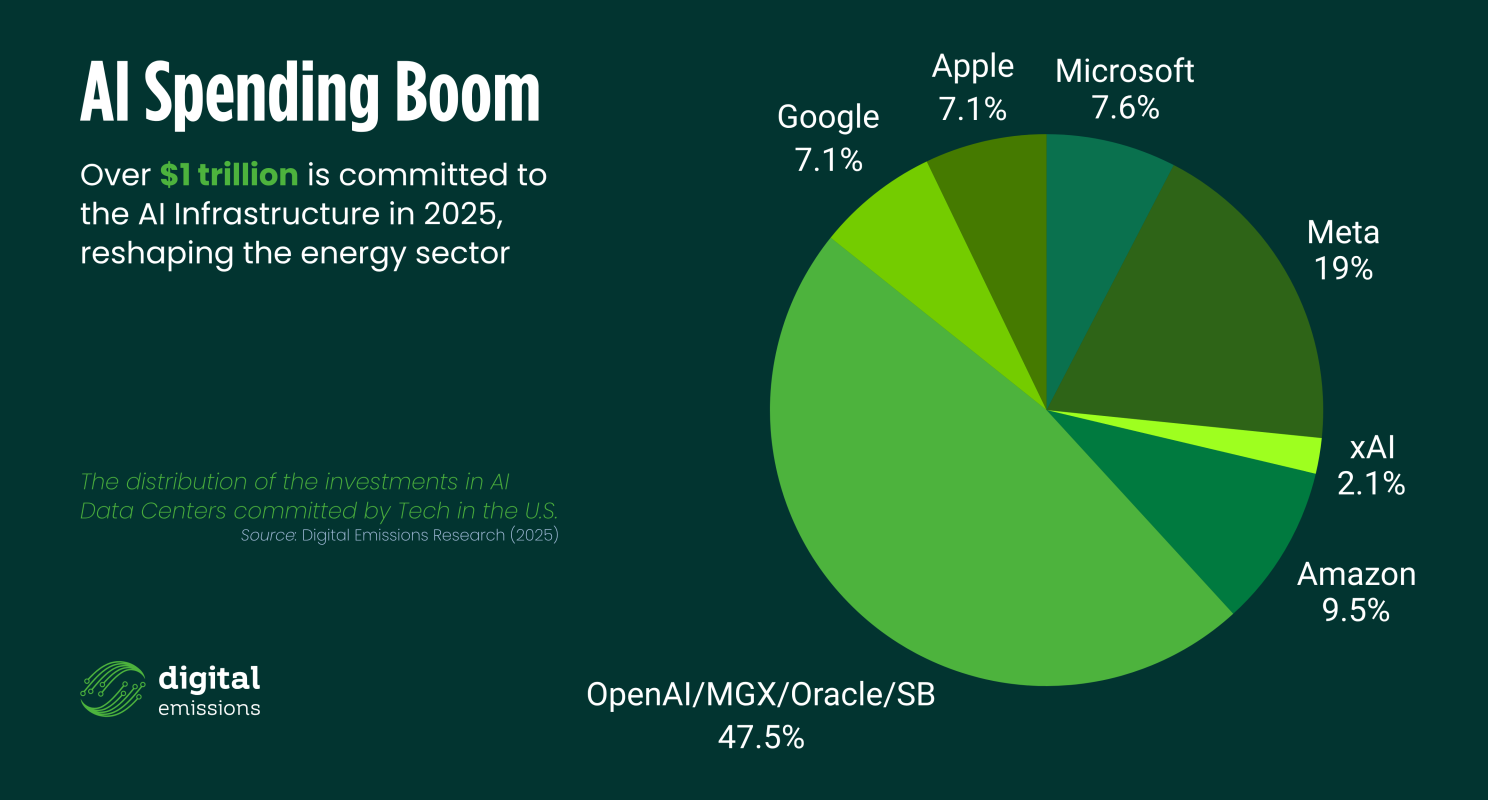
The scale of investment is striking. Meta alone has expanded its AI infrastructure commitments from $50 billion in 2024 to an enormous $600 billion over the next 3 years, according to its CEO Mark Zucherburg. Infrastructure has become the new competitive moat, but the implications reach far beyond technology. But these massive digital factories come with a cost. These facilities run “Always-On AI,” drawing power continuously and requiring vast physical space, water, and other resources.
The United States already hosts more than 5,000 data centers, from Virginia’s northern hub to desert campuses in Arizona and Nevada. These facilities use around 4 percent of all U.S. electricity in 2022. By 2030, AI data centers alone could require up to 14 percent of national generation capacity. A single large 1GW AI data center can draw as much electricity as 750,000 US homes. OpenAI’s Stargate data center cluster alone draws more power than New York City during hot summer days. There’s never been a technology that's hungrier for energy like AI.
While companies like Google and Microsoft have made bold commitments to carbon neutrality, data centers nationwide still derive more than half of their electricity from fossil fuel power plants, with utilities unable to scale renewable capacity fast enough to meet the explosive growth in demand. In some cases, this energy crunch is forcing companies to rely directly on fossil fuel generators. Microsoft's new Mexico data center, for example, operates on gas generators because the local grid simply can't support its massive power requirements. xAI installed 35 gas turbines in Memphis to accelerate its AI Data Center buildout. Texas alone has over 100 new gas power plants planned to meet AI server demand. Developers in Texas have filed plans for more than 100 new gas-fired plants primarily to power servers. Such exploding carbon-intensive energy use is also derailing Big Tech’s 2030 net-zero promises.
Electricity demand is only part of the equation. The grid was already under strain from the rising electrification and extreme weather. Over 70% of U.S. grid infrastructure has exceeded its intended lifespan. Some date back to the 1960s. Not to mention, the U.S. is falling far behind on building high-voltage transmission lines. For example, the U.S. has built only 375 miles in the 2020s, compared to China’s 8,200 miles for the same period.
And AI is not helping. AI now represents one of the greatest single new demands on the system. Even before accounting for AI's energy demands, the grid faces mounting threats from extreme weather, e.g., the latest Summer heat waves pushing the grid limits. Several strategies can help balance growth with sustainability. Accelerating approvals for clean-energy projects and transmission lines, while maintaining environmental safeguards, can reduce reliance on fossil fuels. Modernizing the grid with new high-voltage lines, energy storage, and storm hardening is critical to meet rising loads and integrate renewables. Alternative low-carbon energy sources, e.g., Nuclear partnerships, geothermal projects, recycled EV batteries, etc., need strong policy support to grow. Choosing locations with abundant renewable potential, lower water stress, and strong transmission links can also help.
The trillion-dollar AI buildout is not just a technology story. It is a climate story ranging from natural resources to the energy transition. Emissions are rising, and net-zero timelines are at risk, yet framing the situation only as a necessity due to the AI Arms race overlooks the opportunity for innovation and coordinated action. The same companies driving AI’s growth can also pioneer low-carbon technology. The real challenge is scale and timing. Can policy and industry together modernize the grid quickly enough to handle the load? Can emerging energy sources like small modular reactors, advanced geothermal, and large-scale storage mature before gas plants lock in emissions for decades? For those of us working in or alongside this industry, the task is to move the discussion beyond confrontation and toward solutions. AI does not have to conflict with climate goals, but making them align will require deliberate choices, accelerated innovation, and smarter policy.
