
The Carbon Cost of an Email: Habits to Go Green
Email feels weightless. You type a few lines, hit send, and the message vanishes into thin air. Nothing is printed, nothing is shipped, nothing is thrown away. It is easy to assume the whole thing costs the planet nothing at all.
It doesn't. Behind that weightless feeling sits a very physical machine: the device in your hand, the wireless and fiber networks that carry the message, and the data centers that route, process, and store it, often for years. Every one of those stages runs on electricity, and most of the world's electricity still comes from burning fossil fuels. So each email carries a small climate cost, on both the sending and the receiving side.
One email is close to nothing. That is the whole problem. We send so many that "close to nothing," multiplied across the planet, turns into something worth paying attention to. This guide walks through where those emissions come from, how big the total really is, why your individual habits matter more than they appear to, and ten practical changes you can start this week.
Where an email's emissions actually come from
When people picture "the cloud," they imagine something soft and far away. In reality the cloud is a global estate of warehouses packed with servers, humming around the clock and drawing enormous amounts of power for both computation and cooling. Your email touches that estate every time it moves.
A single message generates emissions across four stages:
Your device. The energy your phone or laptop uses while you write, read, and reread the message. Older and less efficient devices cost more.
The network. The wireless towers, routers, and fiber lines that carry the message from you to the recipient.
Data centers. The servers that receive, filter, process, and route the email. Spam filtering, virus scanning, and indexing all take processing power.
Storage. The often-overlooked stage. Once delivered, most emails sit in an inbox or an archive indefinitely, and keeping that data available draws a steady trickle of electricity for as long as it exists.
There is also the carbon embedded in the hardware itself, the mining, manufacturing, and shipping required to build every device and server in the chain. That "embodied" carbon is spread across everything the hardware does, but it is real, and it is one reason keeping your devices longer matters more than obsessing over any single message.
The key takeaway: an email's footprint is not one number. It depends on the device, how long the message takes to write and read, whether it carries an attachment, how many people receive it, how far it travels, and how clean the local electricity grid is. That last factor is why the calculator asked for your location. A message routed through a coal-heavy grid carries more carbon than an identical one routed through a grid running on wind and hydro.
By the numbers: the scale of the global inbox
The reason a near-weightless action matters is volume. Consider the scale.
Roughly 392 billion emails are sent and received worldwide every single day in 2026, according to figures tracked by Statista and the Radicati Group. That is up from about 376 billion in 2025, and the total is projected to pass 424 billion a day by 2028, growing at around four percent a year.
More than 4.6 billion people now use email, well over half the planet.
Close to 45 percent of all email is spam, which works out to roughly 160 billion junk messages a day, according to EmailTooltester and Statista. Almost half of the entire system exists to send, filter, and delete messages nobody wanted.
Now attach a carbon figure to that traffic. Mike Berners-Lee, whose book How Bad Are Bananas? The Carbon Footprint of Everything is the most widely cited source on email emissions, has estimated that global email produced on the order of 150 million tonnes of CO2e in 2019, roughly 0.3 percent of the world's total carbon footprint. Because the volume keeps climbing, more recent estimates run higher, and totals in the hundreds of millions of tonnes a year are plausible depending on the assumptions used.
To make that personal: Berners-Lee's figures suggest an average person's yearly email habit is comparable to driving a small petrol car around 128 miles. Not catastrophic on its own. But it sits inside a much larger digital footprint that is one of the fastest-growing sources of emissions on Earth.
How much carbon does a single email really produce?
This is the question everyone asks, and it deserves an honest answer, because the popular numbers are messier than they look.
The figures you have probably seen quoted, a standard email at around 4g CO2e and one with a large attachment at around 50g CO2e, come from the first edition of How Bad Are Bananas?, published in 2010. They spread everywhere because they are memorable and easy to picture.
Here is the part most articles leave out. In the 2020 edition of the same book, Berners-Lee revised those estimates downward, partly because devices and data centers have become far more efficient. His updated range runs from about 0.03g for a spam email caught by a filter, to 0.3g for a short email read on a laptop, up to around 17g for a long message that takes ten minutes to write and three minutes to read, and roughly 26g for a mass mailing blasted to a hundred people who mostly ignore it.
More recent working estimates land in the same lower band. The James Hutton Institute, analyzing its own staff email in 2026, used roughly 0.3g for a short email and 0.6 to 1g for one with a small attachment, averaging about 0.5g per message once you blend the mix.
So which number is right? All of them, and none of them. The truth is that per-email figures are rough estimates with wide error bars, and the sensible way to read them is directional rather than precise:
A plain text email is cheap. A short one is very cheap.
Attachments and heavy formatting cost meaningfully more, often ten times as much or higher, because large files force prolonged processing and repeated storage across servers.
Recipients multiply everything. Sending to twenty people is not one email's worth of carbon, it is twenty.
Storage is the slow burn. An email you never delete keeps costing a little, quietly, for years.
If you want a single mental model, use this: it is not the gram-per-email that matters, it is the grams times billions, and the share of those billions that were never worth sending.
Why your individual actions matter (even though one email is tiny)
Here is the objection worth taking seriously. If the entire global email system is only about 0.3 percent of world emissions, and your slice of that is a rounding error, why bother changing anything? Flights, home heating, and what you eat all dwarf your inbox. That is true, and any honest guide should say so plainly. Trimming your email will not offset a long-haul flight.
And yet the case for doing it is stronger than the raw number suggests. Four reasons.
Aggregation is the entire point. Every large problem made of tiny actions looks pointless at the level of one action. The math only works in reverse: 160 billion daily spam messages exist because the cost of sending each one rounds to zero. Restraint scales the same way it does harm.
In a team, you are a multiplier, not a drop. A single reply-all to a forty-person thread, a large attachment sent instead of a link, a "just in case" CC: each of these copies your footprint across every recipient and every device that stores it. Clear, targeted communication is a force multiplier for a whole organization, not just for you. The Hutton found that its own staff received far more email each month than they actually opened, which means a large share of the traffic, and its carbon, was generating no value at all.
The rebound effect works against you. As digital communication gets cheaper and easier, we use more of it. Efficiency gains in data centers keep getting swallowed by rising volume, so total emissions do not fall as fast as they should and can even climb. Deliberate restraint is one of the few things that pushes back on that curve.
The co-benefits are immediate and personal. This is the quiet reason the habit sticks. A leaner inbox means less stress, sharper focus, and less time lost to noise. The average knowledge worker spends around 28 percent of the workweek on email, roughly thirteen hours, according to the McKinsey Global Institute. Cutting the junk buys back some of that time. It also lowers storage costs and makes your real messages easier to find. Berners-Lee himself frames email less as a climate problem to solve and more as a doorway: a low-stakes, everyday way to start noticing, and cutting, the waste threaded through the rest of our lives.
That is the real value of measuring your inbox. Not because email will save the climate, but because it builds the habit of carbon awareness on something small enough to actually change today.
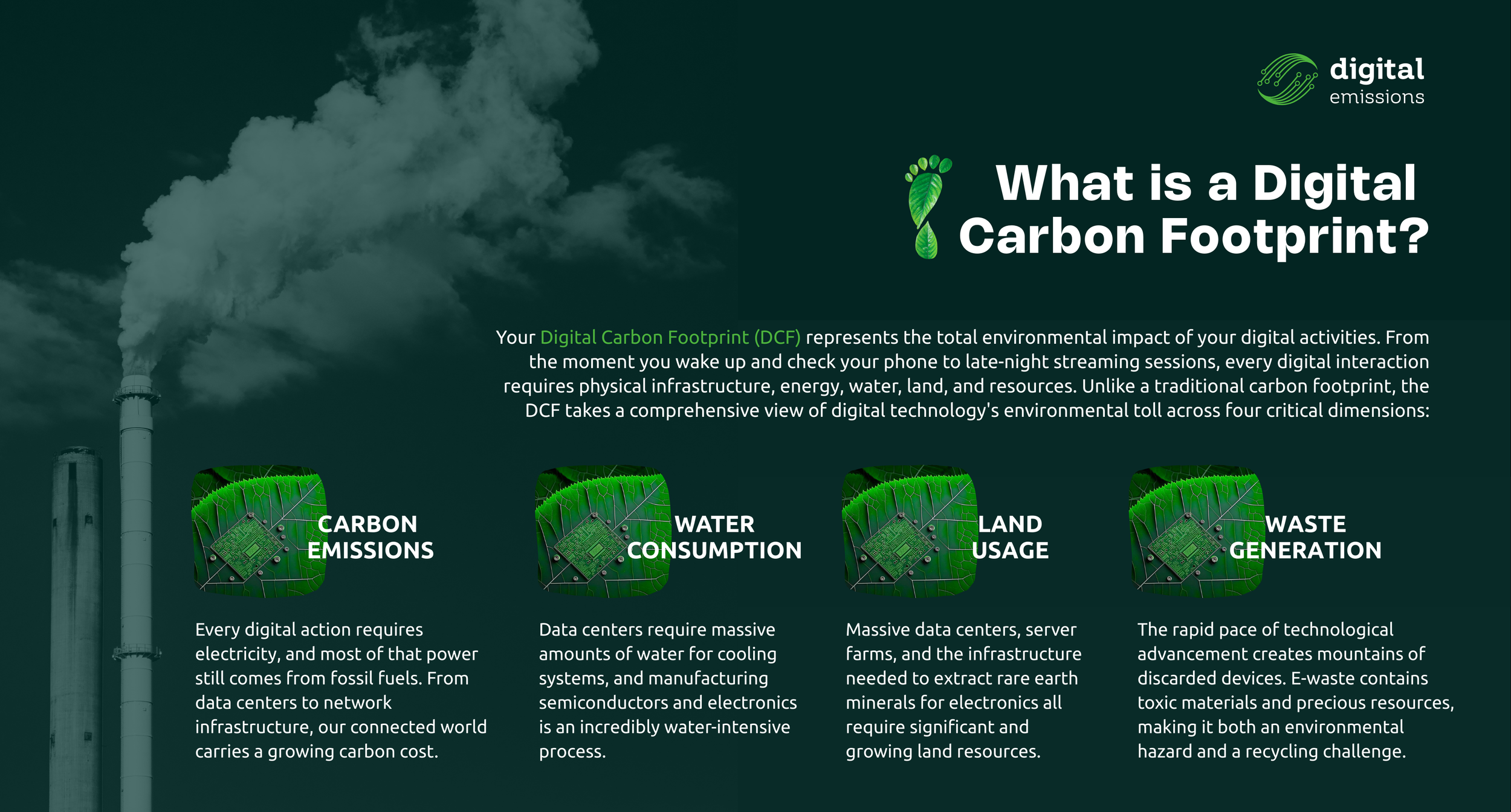
The digital sector now accounts for roughly 4% of global greenhouse gas emissions, more than the entire aviation industry, and that figure is on a trajectory to double. But transformation is possible. Below is a consolidated set of the most impactful, evidence-backed actions you can take, drawn from researchers, sustainability organizations, and digital footprint experts worldwide.
Top ten tips to shrink your email carbon footprint
Ordered roughly from highest impact to nice-to-have. Most take minutes.
Tip 01 - Unsubscribe, and do it monthly.
Newsletters and promotions you never open are pure waste, sent, filtered, and stored for nothing. Book a ten-minute “inbox audit” once a month and clear every list you no longer read. For heavy subscribers this alone can remove a meaningful chunk of annual email carbon.
Tip 02 - Share links, not attachments
A one-megabyte file sent to twenty people, then stored in twenty inboxes, is one of the most carbon-heavy things you can do by email. Upload it once to shared storage (Drive, SharePoint, Dropbox) and send the link instead.
Tip 03 - Send fewer, clearer emails
Every message you send may spawn a chain of replies. A precise subject line and a complete first message (“Decision needed by Friday on venue booking, options below”) lets people act without a back-and-forth, cutting the total number of round trips for everyone.
Tip 04 - Trim the recipient list
Before you send, cut anyone who does not truly need it. Reply-all and defensive CCs are where individual footprints quietly multiply across a whole team.
Tip 05 - Skip the courtesy emails
“Thanks!”, “Noted”, “Got it.” These carry almost no information and real cost when multiplied across a workforce. Move quick exchanges to a chat platform where they stay in one thread, or simply let them go.
Tip 06 - Batch your checking
Constantly reopening your inbox keeps servers active and fragments your attention. Set two or three fixed email windows a day and close the client in between. Fewer server pings, lower device time, and better focus.
Tip 07 - Compress before you attach
When an attachment is unavoidable, compress images and documents first. A smaller file means less transmission and less storage on every device it lands on.
Tip 08 - Clean up storage periodically
Old emails and large attachments keep drawing a trickle of data-center energy for as long as they exist. A quarterly purge of messages older than a year that you will never need again reduces that ongoing footprint. This is a modest lever, not a magic one, but it compounds.
Tip 09 - Report and reduce spam
Mark junk as spam so filters learn, and be selective about where you hand out your address. Turning off automatic image loading in your client also cuts a little data on every marketing email.
Tip 10 - Go light on formatting
Prefer plain text or lightweight HTML over image-heavy templates, and strip oversized logos and banners from your signature. Lean email bodies cost less to move and store, message after message.
Two bonus moves for the ambitious. Keep your devices longer, since the carbon embedded in manufacturing a new phone or laptop usually outweighs years of email use. And if you are choosing infrastructure, favor providers that run on renewable-powered data centers.
Common myths, cleared up
"Deleting all my old emails will make a huge difference." Storage is a real, ongoing cost, so a cleanout helps. But it is a small lever. The bigger win is not receiving and sending junk in the first place, so you never store it at all.
"Email is worse for the planet than paper mail." No. Email is dramatically lower carbon than printing and physically shipping a letter. The goal is to cut digital waste, not to abandon email for something worse.
"These numbers are exact." They are not. Per-email figures are estimates with wide ranges, and reputable sources disagree by an order of magnitude. Treat them as a compass, not a scale.
"My inbox is a drop in the ocean, so it's pointless." True at the level of one message, false at the level of a habit repeated by billions of people every day. The ocean is made of drops.
The bigger picture
Your inbox will not decide the fate of the climate. Nobody serious claims otherwise. What email offers is a starting point, a piece of your footprint small enough and visible enough that you can actually change it this week, and in doing so, start seeing the rest of your digital life through the same lens.
That is the point of measuring it. Not guilt over a message, but literacy about a system. The habits that lighten your inbox, sending less, storing less, wasting less, are the same habits that lighten everything else. Small, consistent changes, repeated across an entire inbox and every account you own, compound into something that matters over a year.
The most useful thing you can do with your calculator result is not to feel bad about it. It is to pick two or three habits from the list above and start.
Frequently Asked Questions
-
Somewhere between roughly 0.03g for a filtered spam message and about 50g for one with a large attachment, depending entirely on device, length, attachments, recipients, and grid. A plain short email is often quoted at around 0.3g to 4g. Read these as ballpark figures, not precise readings.
-
Somewhere between roughly 0.03g for a filtered spam message and about 50g for one with a large attachment, depending entirely on device, length, attachments, recipients, and grid. A plain short email is often quoted at around 0.3g to 4g. Read these as ballpark figures, not precise readings.
-
On its own, no. Email is a small slice of a person's total footprint. Its value is different: it is an easy, daily, visible action that builds the habit of noticing and cutting waste, and in a team it scales into something real.
-
A little. Stored data draws energy continuously, so clearing what you will never need reduces that. Just do not expect it to be transformative. Preventing junk is more effective than deleting it later.
-
Yes, relatively. Adding a file can multiply a message's footprint many times over because large files require more processing, transmission, and repeated storage across every recipient. Sharing a link is almost always the greener choice.
-
Because it still gets sent, filtered, and often stored on your behalf, and it makes up nearly half of all global email. Unsubscribing, reporting junk, and guarding your address all trim the volume of pointless traffic in the system.
-
For short, quick exchanges, usually yes, because moving a rapid back-and-forth into one thread avoids a pile of individual messages, each with its own overhead. For substantial or formal communication, a single well-written email can be more efficient than a flurry of chat pings. Match the tool to the task.
-
Yes, which is why the calculator asked. The same email carries different emissions depending on how clean the local electricity grid is. A message powered by renewables is lighter than one powered by coal, so where the servers and users sit genuinely matters.
-
Send less, to fewer people, with fewer attachments, and unsubscribe from what you never read. Reducing volume at the source beats every other tactic, and it happens to make your inbox calmer too.
-
They can help, since providers running on renewable energy shift the underlying power mix behind your messages. It is a smaller lever than changing your own habits, but a worthwhile one if you are choosing between services.
