
Not-So-Quiet: Why Data Center Noise Is Becoming a Community Issue
Data centers are often described as invisible infrastructure. They sit behind fences, windowless and anonymous, quietly powering the services that underpin modern life. Unlike power plants or factories, they rarely emit smoke or discharge waste into nearby rivers. For years, this perceived quietness helped data centers avoid the kind of scrutiny faced by other forms of industrial development. Yet for many communities living near these facilities, the idea that data centers are silent has proven misleading. As hyperscale campuses multiply across the United States, noise pollution has emerged as an under-examined but increasingly consequential impact of digital infrastructure.
Always-On Sound
Unlike episodic industrial noise, data center sound is persistent. Cooling systems operate continuously to keep servers within narrow temperature ranges. Large air handling units, chillers, cooling towers, and ventilation fans generate a steady mechanical hum that does not pause at night. Transformers and substations emit low-frequency noise as electricity is stepped down and distributed across server halls. Backup diesel generators, required by reliability standards, are tested regularly and can be audible across wide areas. In a growing number of cases, on-site gas turbines now run continuously as primary power, adding another layer of sound to facilities once defined by their cooling systems alone. Individually, none of these components may seem disruptive. Together, they create a constant acoustic presence that nearby residents experience not as an occasional disturbance, but as a permanent background condition.
What makes data center noise particularly difficult to manage is its character. Much of it sits in the low-frequency range, producing a deep hum or vibration rather than sharp or intermittent sounds. Low-frequency noise travels farther, penetrates buildings more easily, and is harder to block with conventional insulation. Residents living near data centers often report that the sound is most noticeable at night, when ambient noise drops and cooling systems continue operating at full capacity. Even when measured decibel levels fall within legal limits, the subjective experience can still be intrusive. This gap between regulatory compliance and lived experience sits at the heart of many disputes.
Real-World Conflicts
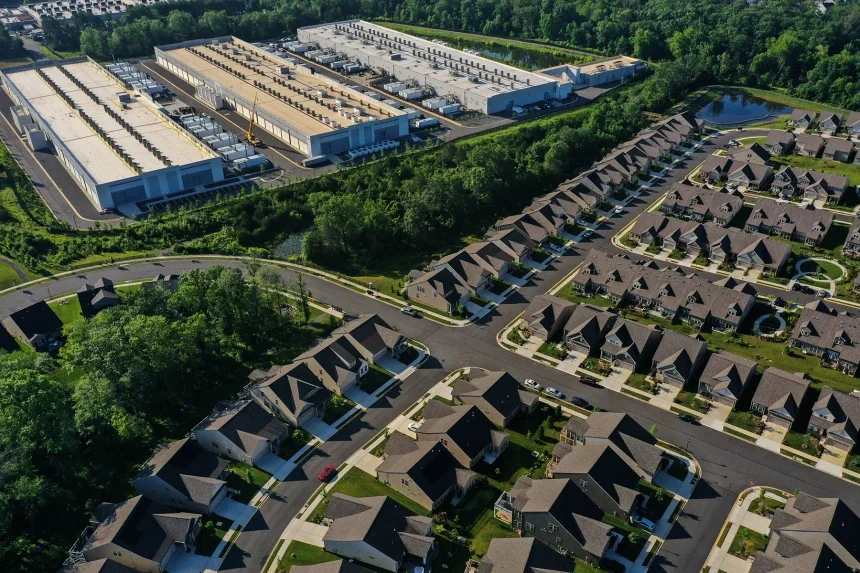
The issue tends to surface first in suburban and rural areas where data centers are frequently sited. These locations offer cheaper land, fewer zoning conflicts, and proximity to transmission infrastructure. But they are also places where ambient noise levels are traditionally low. In such settings, the introduction of continuous industrial sound can feel especially disruptive. In parts of Northern Virginia, home to the densest concentration of data centers in the world, residents have raised concerns about transformer noise and cooling fans operating near residential developments. Similar complaints have emerged in parts of Arizona, Texas, Ohio, and Georgia, where large campuses have expanded rapidly near growing suburban neighborhoods. Chandler, Arizona, became one of the first U.S. cities to respond with a dedicated data center ordinance, requiring baseline noise studies, acoustic consultants, and annual peak-operation testing.
Noise disputes are rarely the sole issue. They often intersect with broader concerns about land use, traffic, visual impact, and property values. But noise has a unique ability to erode the quality of life over time. Studies on chronic environmental noise link prolonged exposure to sleep disruption, stress, and reduced well-being. While data centers are not airports or highways, their round-the-clock operation means exposure is continuous rather than episodic. For communities accustomed to quiet evenings and dark skies, the psychological impact can be significant even when formal health thresholds are not crossed.
Nathan Howard - Getty Images
Regulatory frameworks have struggled to keep pace with this new form of infrastructure. Many local noise ordinances were written decades ago with short-duration or daytime industrial activities in mind. They often rely on average decibel limits measured over brief intervals and may not adequately account for low-frequency sound or nighttime sensitivity. Enforcement can be inconsistent, and measurement itself is complex. Low-frequency noise is harder to capture accurately with standard monitoring equipment, and its effects are not always reflected in simple numerical thresholds. As a result, residents may feel dismissed even when their complaints are legitimate, while operators can point to technical compliance.
The Developer Perspective
From the perspective of data center developers, noise is rarely intentional. Most facilities are designed to meet regulatory requirements, and many operators are surprised by the intensity of community reaction. Cooling systems and electrical equipment are selected primarily for efficiency, reliability, and cost. Noise mitigation is often addressed late in the design process or retrofitted after complaints arise. At that point, solutions such as sound walls, acoustic enclosures, or redesigned airflow paths can be expensive and imperfect. Early planning would allow for better outcomes, but the pace of deployment in the current AI-driven expansion has often prioritized speed over local optimization.
Paths to Mitigation
There are, however, clear pathways to reduce noise impacts. Advances in cooling technology have produced quieter fan designs, variable-speed systems that reduce output during low-demand periods, and alternative cooling approaches that rely less on large external air handlers. Locating noisy equipment away from residential boundaries, using earthen berms or landscaped barriers, and designing buildings to direct sound upward rather than outward can all materially reduce exposure. In some cases, relocating generators or enclosing transformers has resolved persistent issues. These are not experimental solutions. They are established practices in other industries that can be applied more consistently to data centers.
Community engagement matters just as much. Noise conflicts tend to escalate when residents feel excluded from siting decisions or learn about facilities only after construction begins. Transparent communication about expected sound levels, operating patterns, and mitigation plans can build trust and reduce opposition. In some jurisdictions, developers have begun offering independent noise assessments and ongoing monitoring as part of their approval process. These measures do not eliminate impact, but they acknowledge that data centers are physical neighbors, not abstract digital assets.
The broader significance of data center noise lies in what it reveals about the changing nature of infrastructure. Digital services are often framed as weightless and dematerialized, but the facilities that support them are increasingly industrial in scale. They draw large amounts of power, use water for cooling, occupy extensive land, and generate sound. As AI workloads increase density and cooling intensity, these physical effects become harder to ignore. Noise joins electricity demand and water consumption as a constraint that shapes where and how data centers can be built.
A North Star for the Future
Looking ahead, the question is not whether data centers should exist, but how they can be integrated more thoughtfully into the communities that host them. Noise is a solvable problem — but only if it is treated as a core design consideration rather than an afterthought. As with energy and water, addressing noise early is cheaper and more effective than reacting later. It also signals a shift in how the tech industry understands its footprint. Responsible scaling means recognizing that digital infrastructure has local consequences, even when its benefits are global.
As the cloud expands and artificial intelligence becomes embedded in daily life, the pressure to build quickly will remain strong. Yet the success of that expansion will increasingly depend on public acceptance. Communities are more likely to support data centers when their concerns are acknowledged and mitigated. In that sense, noise pollution is not just an environmental issue. It is a test of whether the digital economy can grow in a way that respects the places and people it depends on.
